
It was back in 2019 that I wrote up some thoughts about my Panasonic Lumix GX9. This is a little micro-4/3 mirrorless camera, designed as a lightweight, everyday carry (EDC) that is inconspicuous and discreet. Its interchangeable lenses were likewise small and light, and the mount allowed the use of any m4/3 lens, not just Lumix’s own. I bought mine in 2018, primarily as a relief from the huge, bulky DSLRs I’d been using till that point. My piece about it ended with the question: Is the GX9 a long-term keeper?
To give the BLUF, 8 years on, I still have it, and it still has a place in my photography, even in a world that has gone from 2018’s heavy, bulky DSLRs to more compact full-frame mirrorless cameras.
This is a long piece, so to keep it manageable, I’m not going to include sample images, but you can see some in links to other blog entries, and there is my sample album on Flickr.
What has prompted this post, and a look back at what I wrote in 2019, has been the recent release of the OM System Pen. This is a camera very much in the same spirit as the GX9: a small mirrorless rectangular box aimed at photographers (rather than all-round content creators). While it has a viewfinder, like the GX9, there is no SLR-style hump on top. Its announcement by OM System (a company descended from the camera division of Olympus) was widely greeted with enthusiasm, qualified by the thought that even if it represented an excellent EDC for photographers, in the age of content creators and video-centric distribution platforms, was there really a place for such a camera?
The camera market overall collapsed in the wake of the smartphone revolution (even if it is stabilising). In the spirit of “The best camera is the one you have with you”, many (most?) people have ditched dedicated cameras altogether in favour of their smartphone. For those enthusiastic enough to still want an actual camera, the pull of formats larger than 4/3 — APSC, full-frame (with a sensor the same size as a 35mm negative) and even digital medium format — seems to be dominant. Micro-4/3 seems to me to have ended up as a bit of a back alley: passed by unnoticed by many, even though it can lead to some interesting places.
Does the GX9 still have a place in my photography?
In this context, I’m going to address an obvious question: given that I now have two outstanding full-frame mirrorless cameras, my Sony A7CII and Sony A1, what place does the GX9 still occupy in my photography? To my surprise, used examples of the GX9 go for good prices: at the time of writing MPB lists several of them in excellent condition that are exactly the same price I paid in 2019. The obvious inference from this is that it is not just me who finds the small, capable, interchangeable lens mirrorless cameras still useful; others must too. The announcement of the Pen suggests that OM Systems sees this as a viable market.
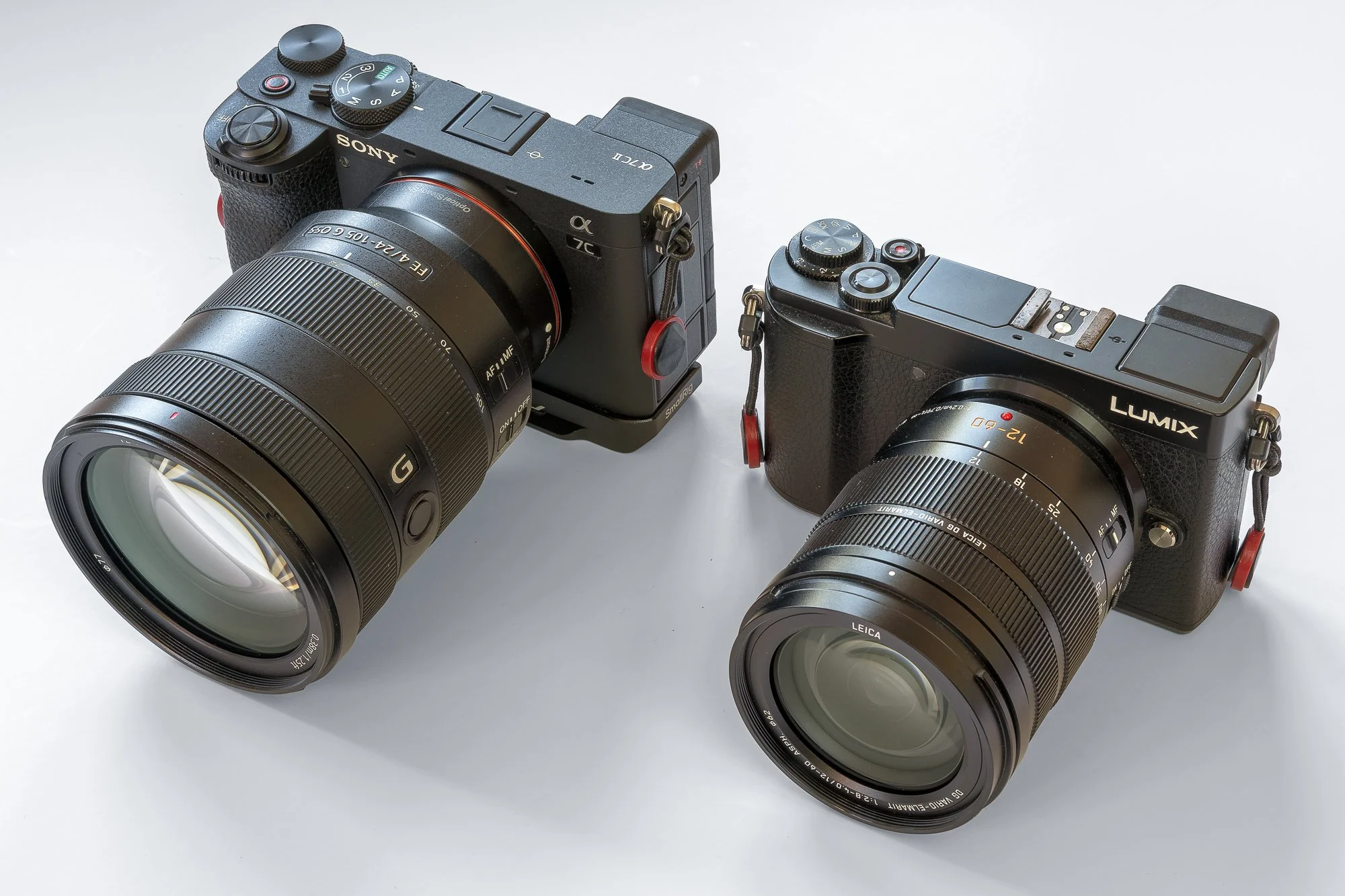
The Sony A7CII puts a full-frame sensor into a body whose frontal dimensions are almost uncannily similar to the GX9. The GX9 is 124 x 72.1 mm across the front; the A7CII is 124 x 71.1 mm. Even the new PEN is only fractionally different at 125.8 x 74.5 mm. The A7CII is only 64 g heavier than the GX9 — 514 g versus 450 g, including battery and card. Essentially, I have two cameras with similar dimensions and design aesthetics that are each very good for some of my main interests, especially street photography and travelling. So why keep both? The GX9 ought to be redundant?
Lenses and overall system size
Well — lenses and overall system size. The thing about bigger sensors is that they require bigger lenses to project an image over the entire sensor. The 4/3 format has always had the advantage that lenses can be smaller than full-frame because the diameter of the image circle produced by the lens only has to be about half the size (43.3 mm full-frame vs 21.6 mm 4/3). What this means is that the size of the camera body does not dictate the final size of what you walk around with: you have to add on a lens.
My favourite type of “photography by wandering about” zoom lens is 24-105 mm or 24-120 mm (in full-frame terms). I have the Sony 24-105mm f/4 and the Panasonic 12-60 mm f/2.8-4.0 (a lens that has a field of view equivalent to 24-120 mm in full-frame terms). The Panasonic 12–60mm f/2.8–4 weighs 320 g. The Sony FE 24–105mm f/4 G OSS weighs 663 g. So the Sony lens is 343 g heavier, or just over twice the weight of the Panasonic lens.
Correspondingly, the total weight of a Sony kit is noticeably heavier. The GX9 with the 12-60mm lens weighs about 770 g; the A7CII with the 24-105mm lens is about 1.18 kg, about 53% heavier overall. The difference of 407 g may not sound all that much, but over a day’s wandering about, it makes a difference.
The GX9 remains a great everyday carry and travel companion
What this means is that the GX9 remains a great EDC. If I go a day out in, say, London with only general street photography in mind, the GX9 with the 12-60mm lens remains an excellent companion. Having said that, if I choose to go out for the day with just one small prime (e.g. the 50mm “Sigmacron”), the A7CII becomes a wonderful choice.
Travelling is another example of where the GX9 is still great. I posted a blog from Nice, for instance, where all the pictures were taken on the GX9. A GX9 kit with the zoom, plus a couple of small primes, fits nicely into cabin baggage when flying without checked luggage; it takes up much less space and weight than a full-frame kit.
I should mention my Thames Project too, as that is consuming much of my photographic energy at present. The previous blog Thames project: Around Marlow showed pictures taken with the GX9, A7CII, Nikon D300 and my iPhone. I didn’t mention which pictures were taken with which camera, and you’re unlikely to be able to tell. Some of those pictures were taken in 2020, in the middle of the pandemic, using the GX9. In my view, they stand up fine. (I’ll just say that the opening picture in that piece “Marlow seen from upstream” was taken on the GX9.)
The GX9 also comes into its own when location scouting. If I’m checking out a location, the light weight of the GX9 and the flexibility of the 12-60mm lens is extremely helpful. If the light is good, I’ll probably get a usable picture. If the light is rubbish, I haven’t had to slog around with a heavy full-frame kit, and I can come back for a specific location when the light is good with the full-frame kit.
When conditions are favourable, the GX9 gives me all the image quality I need. The reason I normally choose the A7CII when I am setting out specifically to make the best photograph I can is that the Sony gives me greater technical headroom. Its larger sensor gives me more latitude in difficult light, more freedom with ISO/shutter speed, and more room to hold highlights and recover shadows. Much of the time I may not need that extra margin, but when the photograph matters, I would rather have it available.
Low light
I mentioned in my original review that I don’t like to use the GX9 at more than ISO 1600. With my Sonys, I don’t even blink at ISO 3200. What has changed since my original blog about the GX9 is the advent of advanced denoising, especially in Lightroom. I’ve reprocessed some pictures taken at high ISO using Lightroom’s Denoise. What I see is that the files lose that brittleness that I talked about earlier. It is easier to get smooth mid-tones and shadows that don’t fall apart. What that cannot do, though, is increase the dynamic range in the files. On Photons To Photos, the GX9 has nearly 2 stops less dynamic range at most ISO values than the A7CII. To put it another way, my rule-of-thumb 7-stop criterion: the GX9 retains about 7 stops of dynamic range on the Photons to Photos chart at about ISO 1200; the A7CII at about ISO 4000. Although in brightly lit London streets at night, the GX9 works fine, especially with modern noise reduction, the A7CII gives extra options for freezing motion or pulling out shadow detail.
Following up on some of the specifics I mentioned originally
There were a few points of perhaps more specialist interest I mentioned in the original piece that are probably worth following up. What has aged well, and what hasn't?
Focus stacking
I commented that I had not got round to using focus bracketing and stacking. Something I had not anticipated is that I occasionally put pictures of camera gear on this blog. To get them sharp throughout, without losing detail to diffraction, it is often advantageous to use focus stacking. Automated focus bracketing was not available on the Nikon D810 when I wrote the original blog, and it was a feature I liked. Most of the product photos I’ve put on this blog have been focus-bracketed images from the GX9, stacked in Photoshop (see, for example, the first picture in this entry).
When I first bought my Sony A1, it was very frustrating that it did not offer this; however, it has been made available via a firmware upgrade. The image of the A7CII and GX9 shown above was focus-bracketed in the A1.
For simple product pictures, the GX9 works just fine, and I’ll probably keep using it for this. The GX9 can do the stacking in-camera and will produce a usable Jpg. Generally, I prefer the added flexibility of processing Raw images in Lightroom before stacking, but that is just personal preference. The Sony cameras don’t process bracketed images in-camera at the time of writing, as far as I am aware.
Multiple exposures
One of my biggest frustrations with Sony is their apparent refusal to support in-camera multiple exposures. My Nikon DSLRs had excellent multiple exposure support. The GX9 has this as well. Building up multiple exposure ICM images really has to be done in-camera as far as I am concerned. There is, of course, a place for making images from multiple exposures in post-processing. But combining ICM with multiple exposures is best done in-camera. ICM is a very iterative process: working out shutter speeds and the kind of camera movement that suits the intended image. Without seeing how the image builds up in camera, there is a risk of bringing back sub-optimal individual images for combining in post. In that sense, the Sony cameras cannot replace the GX9.
4K photo
4K photo — the ability to pull a Jpg still image from a 30fps video was a genuinely helpful feature of the GX9, although I did not use it often. The 9 fps RAW capture on the GX9 was enough for most purposes. Now I have the A1 which will do 30fps Raw, with full autofocus. For street photography, the 10 fps of the A7CII is enough for most purposes (and, yes, HCB could make much better pictures than I ever will with a camera that could do half a frame per second at best, but I am not him). 4K photo would not be a deciding factor in choosing which camera to take out for the day.
The tilting screen
This was something I regarded as a sine qua non for a mirrorless camera, as it meant I could look down at the camera inconspicuously when I didn’t want to disturb the scene. What I’d not anticipated was the general utility of a fully articulated screen, like that of the A7CII. In reality, I find it more generally useful to have a fully articulating screen (e.g. low-angle portrait-format images, and even selfies). In essence, both types of screen are so useful that I can’t ever see myself buying a camera without one or other type. (Or better still, the tilt and flip screen of the A1-II).
The takeway
Eight years on, then, the GX9 has not been entirely left behind by the march of camera technology. My full-frame Sonys are currently my first choice for most of my photography, and if I am setting out specifically to make the best files I can, I will normally take the A7CII or A1 because they give me more operating headroom, especially with difficult light.
But that does not make the GX9 redundant. The concept behind it, a capable camera equipped with genuinely small lenses, has survived remarkably well. When carrying less matters more than having every last bit of image quality available, the GX9 remains my preferred tool. Add a few capabilities that my Sonys still lack, and eight years after asking whether it was a long-term keeper, I seem to have my answer.